
HSE
(PJSC “RussNeft”) in the field of industrial and fire safety, labor and environmental protection ⓘ
Public Joint Stock Company "RussNeft" (PJSC "RussNeft", hereinafter referred to as the Company) is one of the ten largest oil companies in Russia. Health, Safety and Environment (HSE) in the areas where it operates are key priorities and essential conditions for the successful development of the Company's business.
The Company's Industrial and Fire Safety, Occupational Health and Environmental Protection Policy (hereinafter referred to as the Policy) has been developed based on the requirements of the Labor Code of the Russian Federation, Federal Law No. 116-FZ of July 21, 1997 "On Industrial Safety of Hazardous Industrial Facilities," Federal Law No. 7-FZ of January 10, 2002 "On Environmental Protection," Federal Law No. 123 of July 22, 2008 "Technical Regulations on Fire Safety Requirements," Resolution of the Government of the Russian Federation No. 1243 of August 17, 2020 "On Approval of Requirements for Documentation of Industrial Safety Management Systems," and other regulatory legal acts of the Russian Federation, international standards, and global experience in the field of industrial and fire safety, occupational health and environmental protection.
The Company's goals and objectives are to achieve a leading position in the industry in ensuring safe working conditions, industrial and fire safety, reducing the risk of accidents, incidents, emergencies, and fires and eliminating their consequences at hazardous industrial facilities operated by the Company, reducing the negative impact on the environment, and striving for the goal of "Zero": operation with no injuries and damages to the environment or Company's assets.
The Company assumes the following HSE obligations:
- compliance with federal and regional legislations on HSE and rational use of natural resources, and other requirements applicable to the Company's activities;
- hazardous industrial facilities accidents risks mitigation;
- personnel injuries and health damages prevention;
- implementation of industrial control over compliance with industrial safety requirements and management;
- minimization of negative impact on the environment;
- consultations with employees of hazardous industrial facilities and their representatives on industrial safety matters;
- conducting HSE training for the Company's employees, assessing and minimizing risks during work performance, and acquiring knowledge of safe work practices;
- improving the Company's safety culture;
- improving industrial, occupational, environmental, industrial, fire, civil defense, and emergency management systems, taking into account domestic and international experience, and using lessons learned from incidents as a preventative measure;
- To fulfill its obligations, the Company adheres to the following principles:
- improving industrial and fire safety, ensuring the operability of technical equipment, buildings, and facilities, and carrying out their timely upgrade in accordance with established procedures;
- identifying, assessing, and minimizing HSE risks and effectively managing identified risks;
- rational use of natural resources and energy, implementation of low-waste technologies, technologies for the safe accumulation, storage, and disposal of production and consumption waste, and the use of other technologies aimed at reducing the negative impact on the environment;
- monitoring, inspecting, and conducting special assessments of working conditions to ensure compliance with legislative and other requirements applicable to the Company in the HSE areas;
- ensuring personnel competence, supporting and rewarding employees who make a specific contribution to improving safety;
- ensuring the readiness of Company employees, emergency response services, and teams to respond to and eliminate the consequences of potential accidents, fires, and emergencies;
- communicating to suppliers and contractors the obligations of this Policy, as well as HSE standards, regulations, and rules adopted by the Company, and continuously monitoring their implementation;
- information exchange with external stakeholders on HSE matters.
The Company's management assumes responsibility for the implementation of this Policy by establishing appropriate goals and objectives, allocating the necessary organizational and financial resources to achieve them, monitoring and analyzing the Company's HSE activities.
Safety
RussNeft is one of Top-10 oil and gas companies in Russia in terms of oil production output. Life and health of the Company’s employees, industrial safety, and environmental protection in the areas of production are the major priorities and most important conditions for the successful development of RussNeft business.
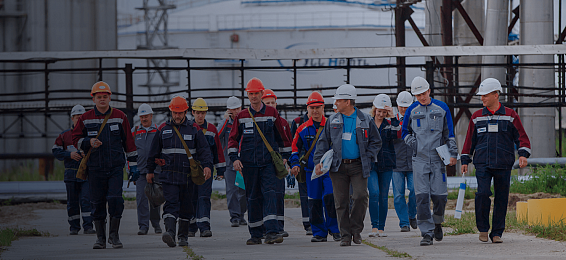
The activities of the Company's structural divisions in the field of industrial, fire safety, occupational safety and environmental protection (hereinafter referred to as ISLPE) are aimed at protecting the life and health of the Company's personnel and contractors while performing production tasks, as well as preserving the Company's property. In their daily work, the primary focus is on compliance with ISLPE legislation and ensuring safe working conditions at hazardous production facilities (HPFs) of the Company and its contractors.
The basic principles of providing industrial safety, labor protection and environmental protection have been formulated by the senior management and are contained in the Company’s Policy on industrial safety, labor protection and environment.
Occupational safety management system
In order to safeguard human life and health, ensure process safety, as well as comply with legislation, the Company has put into effect and is constantly improving the Occupational Health Management System and the Industrial Safety Management System, local regulations governing labor protection, industrial and fire safety, training and testing of workers' knowledge, organization and implementation of four-tier industrial control to ensure safety at hazardous production facilities, incident investigations, medical examinations and psychiatric examinations, providing employees with personal protective equipment.
In accordance with the schedules, training sessions, certification of managers and industrial safety personnel, repairs of equipment, pipelines, tanks, buildings and structures, testing, inspections, technical inspection of diagnostics, industrial safety examinations of process equipment and pipelines, scheduled preventive maintenance of equipment, maintenance and verification of instrumentation and automation equipment are regularly conducted, and industrial safety declarations are developed.
Leadership and safety culture
An important objective for the Company is to develop leadership and strengthen safety culture among employees of RussNeft and contractors and subcontractors. Safety culture is an integral part of the overall corporate culture and business ethics, as well as a basic element of industrial safety management systems.
Key areas for developing leadership and safety culture include:
- involving workers in conscious and active compliance with safety requirements;
- demonstration of safe behavior and commitment to safety on the part of the heads of departments at all levels;
- development of opinions, beliefs and behavioral patterns in employees, focused on the active managing of industrial and professional risks.
Measures to prevent spills and accidents
For the purpose of arranging measures for prevention and elimination of oil and oil products spills, rapid response and effective interaction between those engaged in emergency rescue operations, the Company has developed and put into effect Oil Spill Contingency Plan (hereinafter – the OSCP).
In addition thereto, compliance with safety requirements is checked on a regular basis as part of production control and audits of HSE management system. When nonconformities are identified, corrective and preventive action plans are developed and implemented.
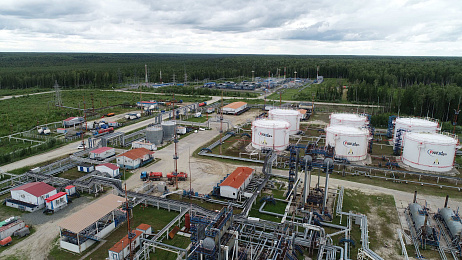
To eliminate emergencies, the branches of RussNeft conclude contracts for service and emergency rescue operations with professional emergency rescue teams to carry out preventive and emergency rescue operations, including those related to oil and petroleum product spills, work to eliminate oil and gas occurrences and open fountains. All branches of the Company are equipped with means to eliminate and contain the consequences of accidents and incidents, as well as with emergency equipment, located directly at production facilities. A reserve of financial and material resources has been created to localize and eliminate the consequences of accidents at hazardous production facilities, and civil liability insurance contracts have been concluded for damage caused as a result of accidents at the Company's facilities.
A high degree of readiness of emergency rescue teams is secured by constant theoretical training, as well as practical training during regular exercises, including the participation of representatives of the EMERCOM of Russia.
Eco Management
Company’s Eco-policy is based on the requirements of environmental laws as well on evaluation of ecological risks and includes a large number of measures, aimed at decreasing adverse impact on environment. Measures are planned for a 3-year perspective, target indicators are set annually.
Evaluation and monitoring
In compliance with the legal requirements and voluntary principles, RussNeft evaluates and monitors the level of environment impact of production activities at all the life cycle stages at facilities with negative environmental impact.
Local environmental monitoring and industrial environmental control are carried out, without limitation, by independent research and scientific organizations, which are selected on a tender basis taking into account professional experience.
Air
The implementation of air protection measures is aimed at reducing emissions of pollutants and efficient utilization of APG.
The emissions reduction is provided through the maintenance and upgrade of equipment and facilities, compliance with process regulations, and monitoring leakproofness of the process equipment.
In order to maintain a 95% level of gas utilization, the following is done: supply of gas to gas processing plants, expansion of the capacity of own electricity generation at gas-engine power plants; commissioning of gas treatment plants, compressor stations, gas pipelines and other facilities.
Reclamation of land
In 2025, the Company transferred after reclamation land plots with an area of 0.12 hectares to the State Forest Fund of the Russian Federation.
Reducing carbon footprint
The Company's management assumes responsibility for reducing carbon footprint by setting appropriate goals and objectives, allocating necessary organizational and financial resources to achieve them and by monitoring and analyzing the Company's activities in the field of sustainable development.
In order to improve the regulation of greenhouse gas emissions, the Company keeps records of greenhouse gas emissions in the state information system of the fuel and energy complex and annually submits a report to the register of greenhouse gas emissions in the "Energy Efficiency" state information system of the Russian Ministry of Economic Development.
As part of the implementation of the climate agenda, the Company developed a pilot Climate Project at the Tagrinskoye field to generate electricity through the APG utilization with implementation dates from July 1, 2024 to June 30, 2034.
In 2025, the project was validated, and in 2026, it is planned to register the climate project in the Register of Carbon Units of the Russian Federation, after which the first stage of the project will be verified, followed by the release of carbon units into circulation.
Currently, the Company has already developed and is successfully implemented “Investment gas program to increase the level of APG utilization”, “Program of energy saving and increasing energy efficiency”, “Action plan for reforestation”.
Further development of these programs in terms of managing climate risks will reduce the level of APG flaring, increase energy efficiency of equipment used in production, treatment and transportation of oil and gas, increase efficiency of the own thermal power generation facilities, which will generally limit the negative impact on environment and reduce carbon footprint.
Participation in environmental campaigns and conferences
The Company regularly takes part in various environmental campaigns, forums, competitions, meetings and conferences, and annually participates in community cleanups held on the territories where the Company operates.
In 2025, the Company took part in the "Garden of Memory", "Save the Forest" and “Forest Volunteers” campaigns, planting seedlings in the Saratov and Tomsk regions and in Khanty-Mansi Autonomous Okrug-Yugra, as well as in the All-Russian environmental campaign "Save and Preserve".